


 EN
 NL
 عربي
From orientation to work profile: the job journey behind the Jobs assistant
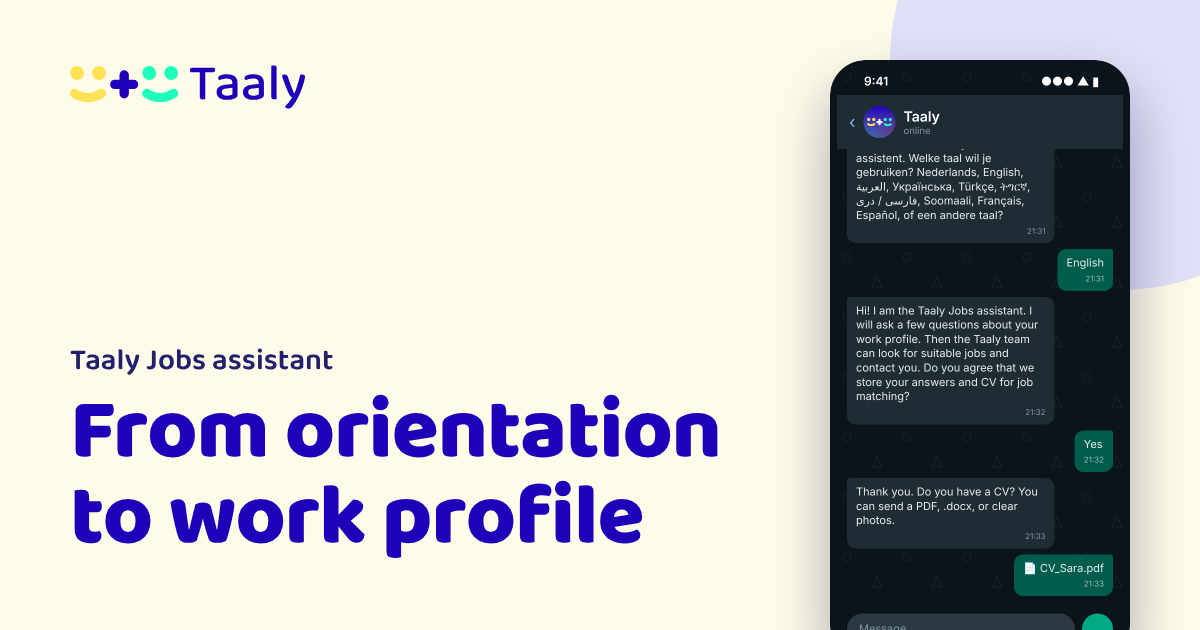
The Taaly Jobs assistant is built on job journeys per occupation: an overview of the steps a newcomer takes from first orientation to a first contract. The assistant handles the first two phases, orientation and screening and conditions, because that is where most questions come up.
A job journey per occupation
A job journey is the route someone takes to reach a goal, step by step. For a newcomer, "becoming a security guard" or "driving for Wmo transport" is not one step. It is a sequence: knowing what the work involves, checking whether you meet the requirements, getting a diploma or a pass, and applying.
We mapped these routes per occupation, from security guard to beautician. Every time, the vacancy turned out to be the last step. Before it, people need to know which papers and diplomas are required. That is where most people drop out, because the information is spread across the websites of different organizations, often only in Dutch.
Phase 1: orientation
In the orientation phase, someone wants to know what an occupation is and what it asks of you. The questions we heard most are concrete. Can I work with my residence permit? Does my diploma from home count? What do I need to become a taxi driver?
These questions have official answers. You can have a foreign diploma evaluated through IDW, so an employer sees which Dutch diploma it compares to, explains NederlandWereldwijd. To become a taxi driver you need a chauffeur card, according to the Dutch government, which requires among other things a category B driving license, a driver diploma, a medical declaration and a certificate of conduct (VOG).
The assistant gives these answers in your own language, with a link to the organization in charge. It does not invent rules: rules can change, and the official organization decides.
Another example is the VOG, a certificate of conduct. Employers ask for it in many occupations, from security to care. You apply for it at Justis, and the organization that asks for it tells you how, explains the Dutch government. Knowing this in advance saves weeks of waiting after an employer has already said yes.
Phase 2: screening and conditions
The second phase is about the person. What experience do you have, what work do you want, when can you start, how far can you travel? And the question employers ask first: are you allowed to work here? So the assistant asks whether you have a BSN and a residence permit that allows work. It never asks for the BSN number itself, and you do not send a passport or ID.
Conversations with newcomers and case managers brought up three things that shaped the design:
- A CV is optional. Many people do not have a Dutch CV. Without one, you answer the questions one by one.
- Experience abroad counts. The assistant asks about all your work, in the Netherlands or in another country.
- Your own language lowers the barrier. People who can answer in their own language tell more about what they can do.
Why the assistant stops here
After the second phase come matching, applying and guidance. There a newcomer needs a person who knows the employer and thinks along. So the assistant deliberately stops after the profile. A member of the Taaly team reads it and gets in touch about vacancies that fit. Nothing goes to an employer without consent.
Meanwhile, in the Taaly app you can browse vacancies yourself in Taaly Jobs, from employers open to newcomers. CV and LinkedIn support and interview practice are in development for 2027.
Read on in why we built the Jobs assistant, or see how the Taaly Jobs assistant works.
Frequently asked questions
Which phases of the job journey does the Jobs assistant cover?
The first two: orientation (answering questions about working in the Netherlands) and screening and conditions (building a work profile). After that, a member of the Taaly team takes over.
Can the assistant tell me whether my diploma counts?
It explains how to have a foreign diploma evaluated through IDW and what that means for an employer. The official organization decides.
Does the assistant ask for my BSN?
It only asks whether you have a BSN and a residence permit that allows work. It never asks for your BSN number, passport or ID.